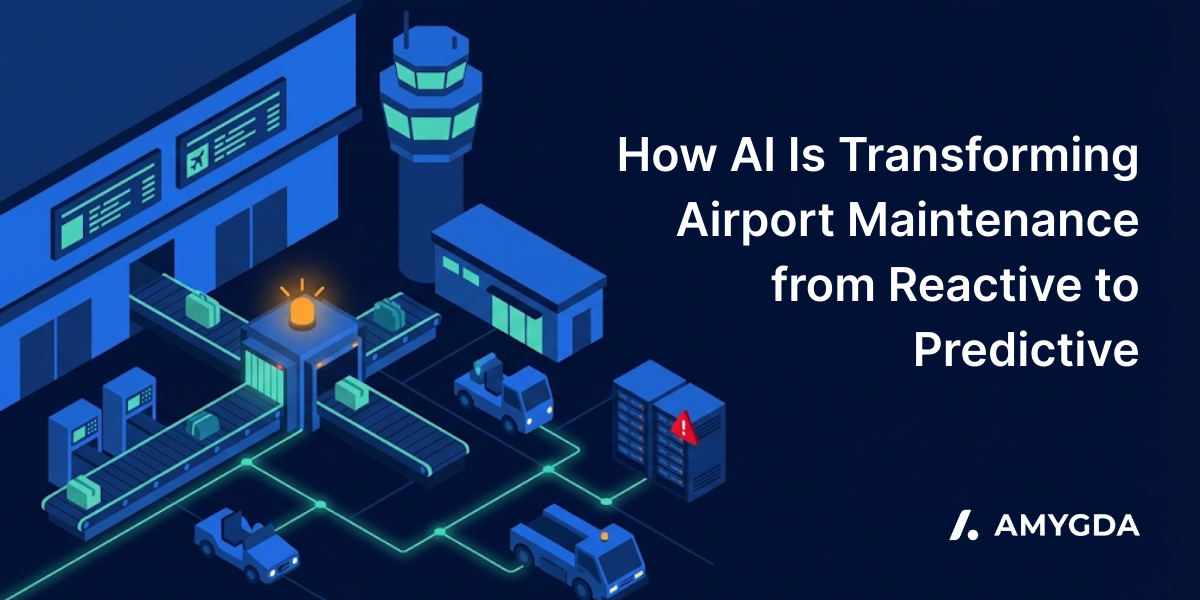
Airports operate like a smart city in themselves! With a lot of smart assets including conveyor belts, scanners, escalators, lifts, and vehicles all working continuously to keep passengers and baggage moving. When any of these systems fail, it can trigger flight delays, baggage disruptions, and operational headaches.
Traditionally (at least as of Dec 2025), airport maintenance has been reactive, with teams fixing machines only after a breakdown occurs or when the OEM decides a part needs changing (because? Only they know, treating all info like a dark secret they hate to share with airport engineering managers).
This approach is:
- costly (time and material / parts based contracts are expensive),
- stressful (to Ops teams), and
- unpredictable (things break at the worst possible time).
And might we add – utterly 2008 oriented – what is the point of an airport having all the smart systems if maintenance is still done like it was some new thing in 2008.
AI-powered predictive maintenance for airports is changing this. By simultaneously analysing sensor data, equipment logs, ERP records, and technical reports, AI detects the early, often-hidden signs of wear or potential failure that human teams would miss or take weeks to identify.
Rather than responding to breakdowns, maintenance teams now receive actionable insights weeks or months (yes! Amygda’s AI platform in some cases gives up to two months warning) in advance, allowing them to act before equipment stops working.
The result is improved reliability, reduced downtime, extended asset life, and lower operational costs.
With predictive maintenance, airports are moving from constantly reacting to unexpected downtime to a more predictable approach, planning maintenance efficiently, and keeping operations running smoothly.
Still a new topic, in exactly how airports can transition from reactive to predictive maintenance, the rest of this article will explore how airports can transition from reactive to predictive approaches in practice.
The Three Key Benefits of Predictive Maintenance for Airports
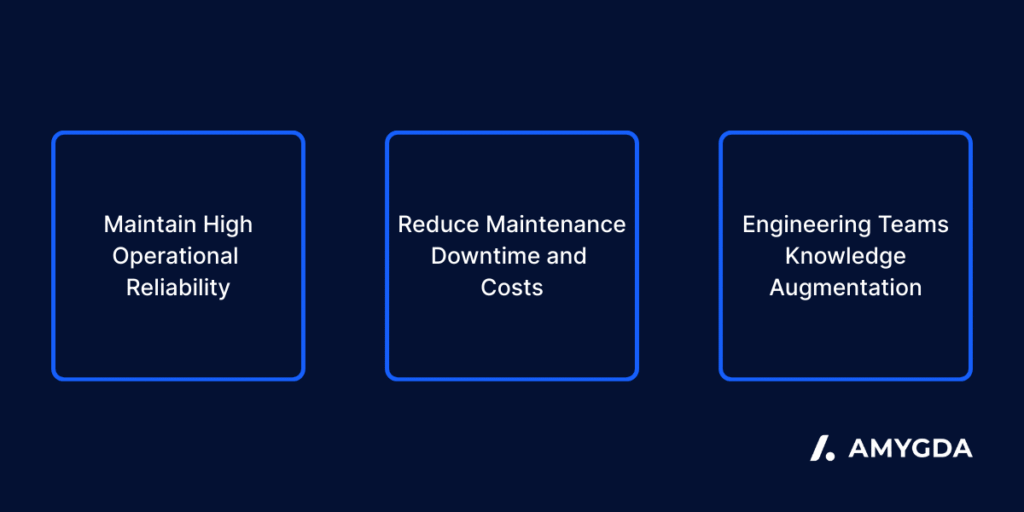
Whilst reduced downtime, increased safety, lower costs are often suggested as key benefits of predictive maintenance, they are surface level, basic benefits. In our decade-plus of knowledge in aviation predictive maintenance (after all, our founders led predictive maintenance analytics capability development at Rolls-Royce) the three overarching benefits that predictive maintenance delivers are:
1. Operational Resilience
Predictive maintenance reduces downtime and ensures equipment is available when needed most. By detecting wear early, maintenance can be scheduled proactively, in some cases extending the life of critical assets and keeping systems running reliably during peak periods. Sometimes the key benefit is not doing maintenance, but rather ‘juice the asset’ as much as you can, risk free, before intervening to do maintenance.
2. Lower Maintenance Costs
AI helps teams plan maintenance at the right time with the right resources. It also uncovers opportunities to optimise workscopes (a huge topic in itself), combining overlapping tasks or scheduling maintenance more efficiently. This reduces repeated effort, parts wastage, and labour costs.
3. Knowledge Augmentation
With fewer experienced engineers available, AI acts as a knowledge coach. By analysing large volumes of operational data, it helps engineers make informed decisions, preserves institutional knowledge, and supports teams with actionable insights.
Output of predictive maintenance for airports
By focusing on these three pillars, predictive maintenance delivers smoother operations, cost efficiency, and empowered teams, all while maintaining high safety standards.
Understanding these benefits is easier when we look at how predictive maintenance actually works in practice.
How AI Predictive Maintenance Works in Airports
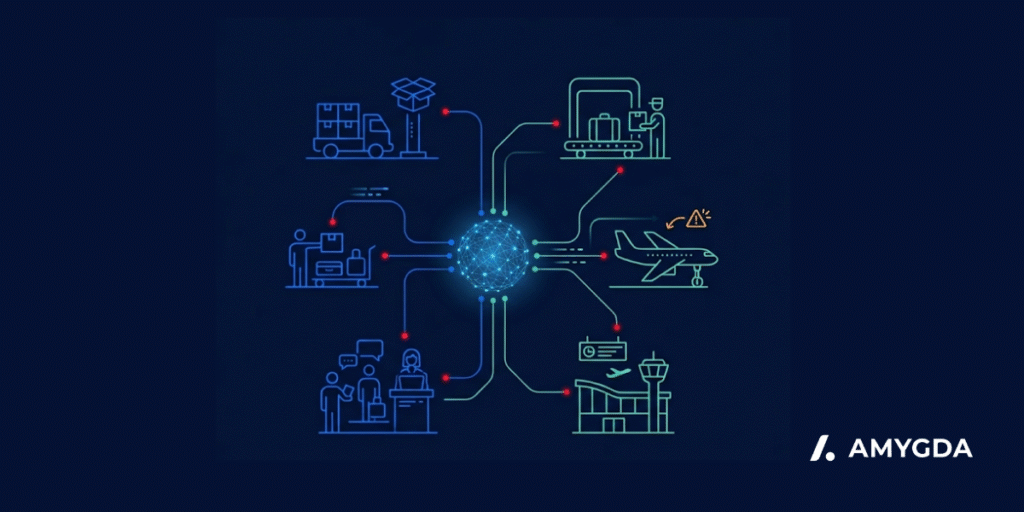
AI predictive maintenance works by continuously collecting and analysing data from sensors, equipment logs, ERP systems, and technical reports. The system identifies patterns that deviate from normal operation, predicts potential failures, and alerts engineers in advance.
Each intervention feeds back into the AI, improving accuracy over time. This creates a continuous loop: sense → analyse → alert → act → learn, turning maintenance from a reactive scramble into a controlled, predictable process.
Implementing predictive maintenance doesn’t require replacing every machine at once. Airports can begin with one critical asset, such as a frequently failing conveyor belt. By integrating key data sources and testing AI predictions, teams can achieve early wins.
Once trust is established, predictive maintenance can be expanded across other systems, generating airport-wide operational improvements. Gradual implementation ensures cost-efficiency and team adoption.
Predictive maintenance is not just about data; it’s about connecting technology to meaningful outcomes — fewer disruptions, smarter maintenance, and stronger operational resilience. Each stage in the process contributes directly to those benefits.
The technical detail behind how an airport predictive maintenance platform works
1. Sensors Capture Real-Time Equipment Data
Airports are full of machines that constantly generate signals — vibration, temperature, sound, and electrical load. Sensors capture these metrics in real time, creating a live health profile of every asset.
Why it matters: By spotting small irregularities early, maintenance teams can act before faults lead to downtime, keeping operations running smoothly and improving overall reliability.
2. Edge Systems Clean and Streamline the Data
Local edge devices filter and summarise raw information, removing noise and focusing on significant trends that may indicate wear, misalignment, or overload.
Why it matters: This ensures that technicians receive only meaningful insights, reducing false alarms and helping teams prioritise work effectively — saving time and effort.
3. AI Models Analyse Patterns and Predict Failures
Machine learning models study historical and live data to understand what “normal” looks like. They detect deviations — like subtle vibration increases or abnormal heat — that signal future faults.
Why it matters: Predicting faults days or weeks in advance allows maintenance teams to schedule interventions efficiently. Tasks can be grouped, resources planned, and parts ordered — leading to lower costs and better resource utilisation.
4. Actionable Alerts Reach the Right Teams
When AI identifies an issue, it alerts technicians with clear, actionable guidance — for example, “motor bearing likely to fail within five days.”
Why it matters: These timely alerts prevent unexpected breakdowns and give engineers time to prepare, reinforcing operational resilience and improving passenger experience.
5. Continuous Learning and Knowledge Augmentation
Each action — whether confirming or correcting an alert — feeds back into the AI system. Over time, it becomes more accurate and more tailored to the specific environment of each airport.
Why it matters: This continuous loop helps bridge the experience gap as senior engineers retire. It allows AI to retain institutional knowledge, supporting both new and seasoned technicians.
Real-World Results: Predictive Maintenance at a Major International Airport
At one of Europe’s busiest airports, Amygda deployed its AI platform across critical baggage handling infrastructure. The results demonstrated the tangible impact of shifting from reactive to predictive maintenance:
- 14-day advance warning: The AI system successfully detected emerging equipment issues an average of two weeks before failure would have occurred
- 80% detection rate: Four out of five potential failures were identified and flagged before causing operational disruption
Amygda’s Role in AI-Powered Airport Maintenance
Amygda provides AI solutions that help airports turn data into actionable insights. By combining sensor readings, maintenance logs, ERP data, and technical reports, our systems allow engineers to act early and confidently.
With Amygda, airports can move from reacting to anticipating, reducing disruptions, optimising resources, and preserving institutional knowledge — all while improving operational resilience and lowering costs.
Transforming Airport Reliability with AI
AI-driven predictive maintenance is redefining airport reliability. By shifting from “fix it when it breaks” to “know before it fails,” airports can enhance operational resilience, reduce maintenance costs, and support their engineering teams. The result is safer, more efficient, and cost-effective operations — and passengers who experience smoother, more reliable journeys.
FAQ
Q1: What is AI predictive maintenance in airports?
A1: AI predictive maintenance uses sensor data, equipment logs, ERP records, and technical reports to detect early signs of equipment wear or failure. This allows airport engineers to plan maintenance proactively, reducing downtime and improving operational efficiency. It is built to do multivariate analysis and not single parameter threshold monitoring.
Q2: How does predictive maintenance improve airport reliability?
A2: By predicting failures before they happen, airports can prevent unexpected disruptions, ensure critical systems remain operational, and maintain smooth passenger flow. This enhances reliability and reduces operational stress.
Q3: Can older airport equipment benefit from predictive maintenance?
A3: Yes. Even legacy equipment can be monitored using small sensors or electrical data. AI analyses historical and real-time data to identify potential issues, enabling proactive interventions without replacing existing systems. Another data source for predictive maintenance is the messy data airports have in logs and maintenance reports technicians write, Amygda is a leading AI company to make sense of this messy data from airport for operational reliability.
Q4: Does predictive maintenance replace human engineers?
A4: No. AI supports engineers by providing actionable insights and early warnings. Humans remain responsible for decision-making, combining their expertise with AI guidance for more efficient and reliable maintenance.
Q5: How quickly do airports see results from predictive maintenance?
A5: Airports typically notice fewer unexpected breakdowns within weeks of implementing AI systems, as early alerts allow teams to intervene before failures impact operations.
Q6: What data sources are used for predictive maintenance in airports?
A6: AI models analyse sensor readings, equipment logs, ERP and maintenance records, technical reports, and monthly updates. Combining multiple data sources provides a more accurate prediction of potential failures.
Q7: How can airports start implementing predictive maintenance?
A7: Airports can begin with one critical asset, such as in BHS or equipment for passenger use. By integrating key data sources and testing AI predictions, teams can achieve early wins before scaling across other equipment.
People Also Ask (PAA)
Q1: How does AI detect airport equipment failures before they happen?
A1: AI analyses sensor readings, equipment logs, ERP data, and maintenance reports to identify patterns that indicate early signs of wear or malfunction. By recognising deviations from normal operation, AI alerts engineers before failures occur, enabling proactive maintenance and reducing downtime.
Q2: What are the benefits of predictive maintenance for airport operations?
A2: Predictive maintenance improves operational resilience, reduces maintenance costs, and supports engineers with data-driven insights. By anticipating failures, airports can prevent disruptions, optimise maintenance schedules, and ensure critical systems remain available for smooth operations.
Q3: Can predictive maintenance help reduce flight delays?
A3: Yes. By preventing unexpected equipment failures, predictive maintenance ensures baggage systems, conveyor belts, and other critical airport infrastructure remain operational. This reduces operational delays and contributes to smoother passenger flow.
Q4: Which airport systems benefit most from predictive maintenance?
A4: Conveyor belts, scanners, baggage handling systems, escalators, lifts, airside vehicles, and HVAC systems benefit most. Any critical system where unplanned downtime impacts operations can see improved reliability and performance through predictive maintenance.
Q5: How do engineers use AI insights to plan maintenance?
A5: Engineers receive early alerts and actionable recommendations from AI, including predicted failure dates and severity. This allows them to schedule interventions proactively, allocate resources efficiently, and combine overlapping maintenance tasks for greater efficiency.
Q6: What is the difference between predictive and preventive maintenance?
A6: Preventive maintenance follows a fixed schedule, regardless of actual equipment condition. Predictive maintenance uses AI to analyse real-time and historical data to determine when maintenance is truly needed, reducing unnecessary work and unexpected breakdowns.
Q7: How much does implementing AI predictive maintenance cost for airports?
A7: Costs vary based on equipment complexity, data integration, and AI solution scale. Airports can start small with critical assets to achieve early benefits, then scale gradually. The reduction in downtime and maintenance costs typically offsets initial investment over time.
Q8: Can AI predictive maintenance extend the lifespan of airport equipment?
A8: Yes. By detecting wear and potential failures early, AI allows maintenance to be performed at the optimal time, preventing excessive strain on components and extending the operational life of critical assets.
Q9: How is sensor data used to prevent airport system breakdowns?
A9: Sensors monitor vibration, temperature, power usage, sound, and other operational metrics. AI analyses these signals to detect anomalies, predict failures, and alert engineers before equipment stops working, ensuring proactive interventions.
Q10: How quickly can an airport see improvements after AI implementation?
A10: Airports often notice fewer unexpected breakdowns within weeks of implementing predictive maintenance. Early alerts allow teams to act before failures occur, improving system reliability and operational efficiency rapidly.